

Ho Chi Minh City, 28 October 2026
In this article, we discuss several key changes applicable to foreign-invested educational institutions, foreign-invested short-term training and further education institutions, and representative offices of foreign educational institutions in Vietnam (collectively, the “Foreign Educational Institutions”) under Appendix IV to Resolution No. 23/2026/NQ-CP (“Resolution 23”), by reference to Decree No. 86/2018/ND-CP (“Decree 86”) and the relevant legal regulations previously in force.
1. Key Changes
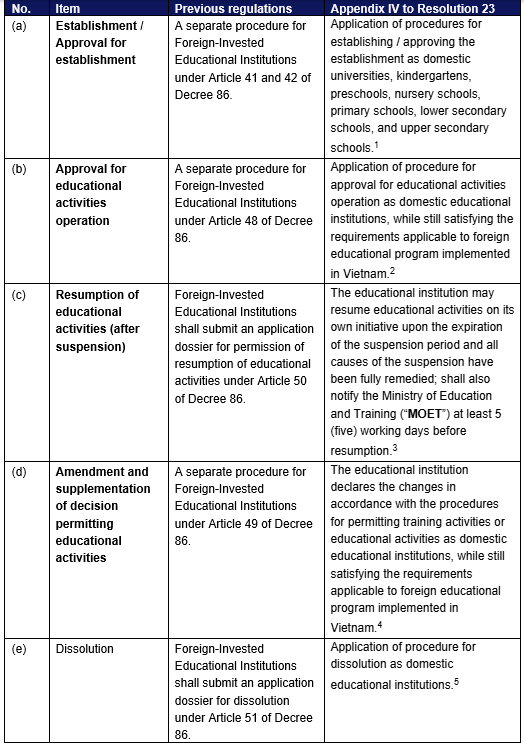
1.1 Foreign-invested higher education institutions, branch campuses of foreign-invested education institutions in Vietnam, foreign-invested preschools in Vietnam, and foreign-invested general education institutions in Vietnam (“Foreign-Invested Educational Institutions”)
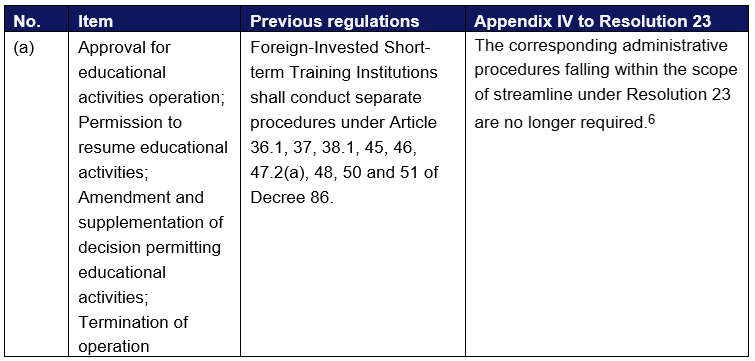
1.2 Foreign-Invested Short-term training and further-training institutions in Vietnam (“Foreign-Invested Short-term Training Institutions”)
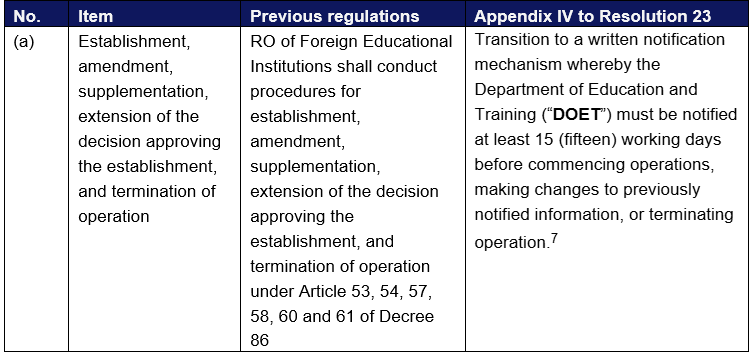
1.3 Representative offices of foreign educational institutions in Vietnam (“RO of Foreign Educational Institutions”)
2. Educational Requirements Must Still Be Satisfied
The streamline of administrative procedures under new Resolutions do not entail the removal of requirements intended to ensure educational quality and learner safety. Accordingly, Foreign Educational Establishments should take note of the following requirements:
(a) Foreign educational programs implemented in Vietnam shall continue to be accredited or recognized by a competent authority or organization in their home country in accordance with applicable regulations;
(b) Foreign educational programs implemented in Vietnam have been delivered in home country for at least 5 (five) years as of the date of submission of the application for registration of educational operations, where this requirement applies;
(c) Foreign educational programs implemented in Vietnam contain no content that adversely affects national defence, security or the public interest, distorts history, or adversely affects Vietnam’s cultural traditions and social values; and
(d) Vietnamese learners shall still undertake the compulsory subjects and educational content prescribed by the Minister of Education and Training.
Under the new mechanism, Foreign Educational Institutions are subject to reduced requirements for obtaining prior approvals for certain activities. However, they remain responsible for ensuring that all applicable operating conditions are fully satisfied and that their operations comply with the law. MOET and DOET will continue to perform their respective regulatory, inspection and supervisory functions within their statutory authority.
3. Practical Considerations for Investors
(a) Application dossiers under administrative procedures that have been abolished and were received by the competent authorities before Resolution 23 took effect (29 April 2026) shall be processed in accordance with the transitional provisions of the Resolution 23; where processing is to be discontinued, the application shall be returned upon the request of the relevant organization or individual. For applications under administrative procedures that have been simplified, the corresponding transitional provisions should be identified to determine the applicable handling process. (8)
(b) Resolution 23 takes effect from 29 April 2026 until immediately before 1 March 2027. Accordingly, Foreign Educational Institutions should monitor and keep abreast of legal instruments promulgated during this period to stay informed of any replacement, amendment or guidance provisions relevant to investment activities in the education sector.
(c) The mechanism allowing educational institutions to resume educational operations on their own initiative and the use of notifications in lieu of certain prior approval procedures increase the institutions’ responsibility for proactive regulatory compliance. Accordingly, educational institutions should retain complete records evidencing the remediation of the grounds for suspension, compliance with applicable operating conditions, and notifications submitted to the competent authorities. Such records are essential for providing explanations during inspections, regulatory examinations or post-implementation reviews.
Conclusion
Resolution 23 marks a shift from a regulatory framework that relies heavily on prior licensing procedures towards a streamlined administrative framework that enhances the autonomy of Foreign Educational Institutions in Vietnam while increasing their responsibility for regulatory compliance.
For investors, taking advantage of the administrative procedures that have been eliminated or simplified should go hand in hand with a review of the type of educational institutions, scope of operations, sector-specific requirements and corresponding notification obligations. Correctly identifying the applicable procedures in each case will help mitigate compliance risks and ensure that educational operations continue lawfully and without interruption.
Footnote:
(1) Sections B.I, B.X, and B.XI of Appendix IV to Resolution No. 23.
(2) Sections B.IV, B.XV, B.XVI, and B.XVII of Appendix IV to Resolution 23.
(3) Section B.VI of Appendix IV to Resolution 23.
(4) Sections B.VII and B.XVIII of Appendix IV to Resolution 23.
(5) Sections B.VIII, B.XII, and B.XIII of Appendix IV to Resolution 23.
(6) Sections B.XIV, B.XVIII, B.XIX, and B.XX of Appendix IV to Resolution 23.
(7) Section B.XXI of Appendix IV to Resolution 23.
(8) Article 5 of Resolution 23.
—
See the previous part here: Part 1
—
If you would like to discuss how Resolution No. 23/2026/NQ-CP may affect your foreign-invested educational institution in Vietnam, or require tailored legal advice, please contact our team:
📧 info@indochinecounsel.com
☎️ (+84) 28 3823 9640