

Ho Chi Minh City, 16 September 2026
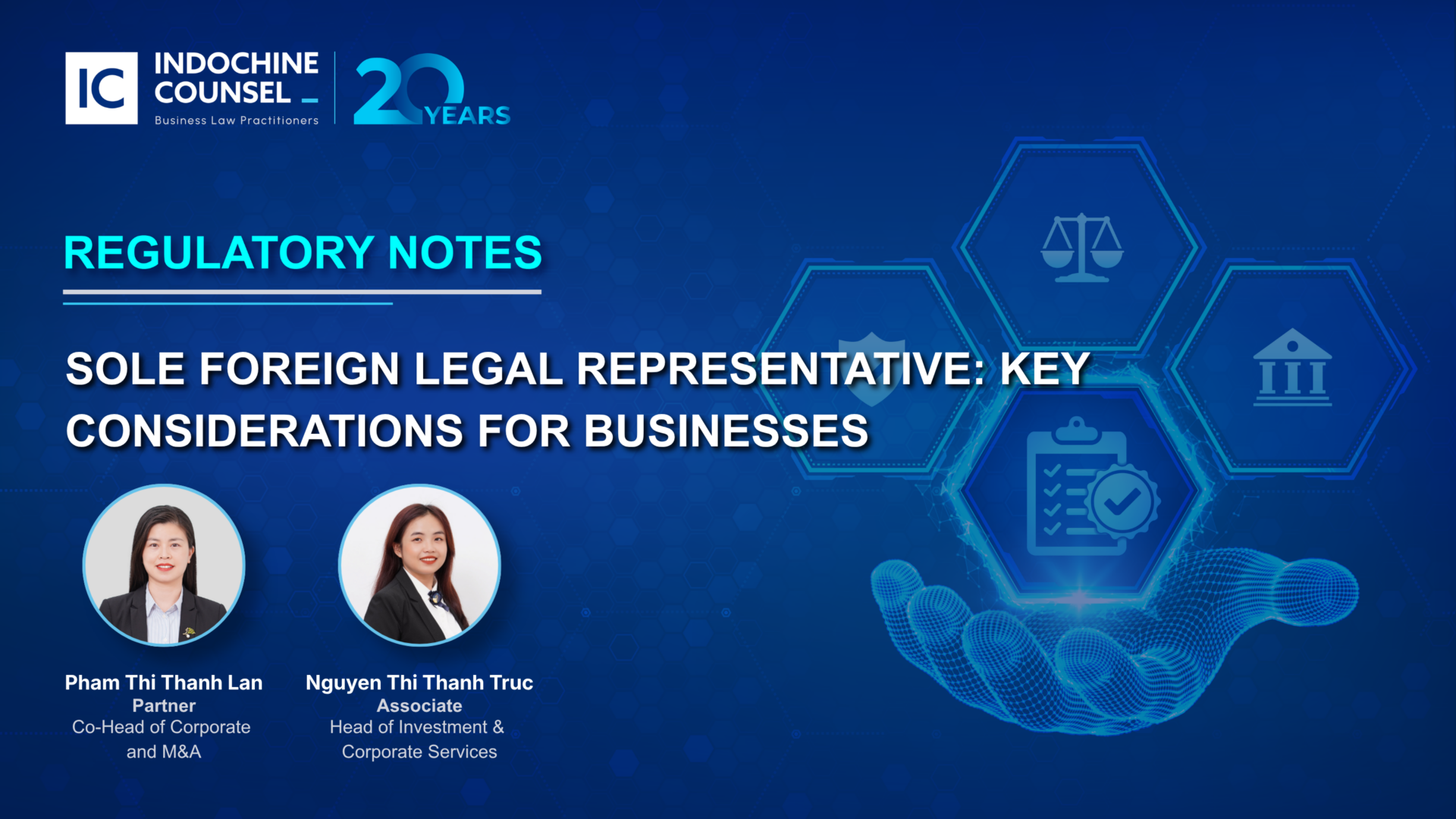
For foreign-invested enterprises (“FDI enterprises”), appointing a foreigner as the legal representative (“Legal Representative”) is a common option when establishing the corporate governance structure in Vietnam. However, having a sole foreign Legal Representative, particularly one who does not regularly reside in Vietnam, may give rise to certain practical issues in the operation of the enterprise.
Notably, the Legal Representative and the authorized representative of the institutional owner, institutional member or institutional shareholder (“Authorized Representative”) perform two distinct functions, but FDI enterprises may still confuse these two positions. While the Legal Representative represents the enterprise itself in legal relations, the Authorized Representative represents the owner, member or shareholder to exercise the rights and perform the obligations of such owner, member or shareholder at the enterprise. Therefore, the appointment of an Authorized Representative does not automatically replace the role of the Legal Representative.
To help foreign investors and FDI enterprises better understand the roles of the Legal Representative, distinguish between the two positions, the Legal Representative and Authorized Representative, and proactively identify issues that may arise when the sole Legal Representative is a foreigner, this article highlights several legal and practical considerations that enterprises should take into account when appointing a sole foreign Legal Representative.
What should businesses note?
1. The Legal Representative and Authorized Representative have different roles
The Legal Representative is the individual who represents the enterprise in exercising rights and performing obligations arising from transactions of the enterprise, represents the enterprise as a person requesting the resolution of civil matters, plaintiff, defendant or person with related rights and obligations before arbitration or court, and exercises other rights and performs other obligations as prescribed by law.
Meanwhile, the Authorized Representative is an individual authorized in writing to act on behalf of the institutional owner, institutional member or institutional shareholder to exercise the rights and perform the obligations prescribed under the Law on Enterprises. Depending on the selected governance structure, a sole Authorized Representative will become the chairperson of a single-member limited liability company, the Authorized Representatives will become members of the Members’ Council of a limited liability company, or the Authorized Representative will represent an institutional shareholder at the General Meeting of Shareholders of a joint stock company.
This distinction has practical implications. An Authorized Representative does not automatically have the authority to represent the company before third parties, and having an Authorized Representative does not mean that the enterprise has a person who can replace the roles of Legal Representative.
2. A sole Legal Representative: residence and authorization upon departure
Vietnamese enterprise law does not prohibit a foreigner from acting as a Legal Representative and the enterprise is permitted to have one or more Legal Representatives. However, the enterprise must ensure that it always has at least one Legal Representative residing in Vietnam.
Where an enterprise has only one Legal Representative and such person leaves Vietnam, the Legal Representative must authorize in writing another individual residing in Vietnam to exercise the rights and perform the obligations of the Legal Representative during his/her absence. The Legal Representative remains responsible for the exercise of the authorized rights and performance of the authorized obligations.
Practical implication: For investors planning to appoint a individual who is currently outside Vietnam as the sole Legal Representative, the enterprise should plan in advance for such person’s residence, and the authorization arrangement when he/she leaves Vietnam.
3. A sole foreign Legal Representative may directly affect post-establishment operational procedures
Some banks may require the Legal Representative to provide a mobile phone number registered in Vietnam under his/her own name and to appear in person before and undergo verification by the bank to complete the company’s bank account opening procedure. If the Legal Representative does not yet have a valid visa to enter Vietnam and is not physically present in Vietnam, the enterprise may encounter difficulties in registering a mobile number under his/her own name and completing the bank account opening procedure. For foreigners, registration of a mobile number in Vietnam under their own name requires the individual to enter Vietnam with a valid passport and visa.
In addition, enterprises established in Vietnam are required to apply for an electronic identification account (VNeID) for the organization. The organization’s VNeID is used to carry out and receive results of administrative procedures and public services in the electronic environment. As an increasing number of administrative procedures, tax filings and tax payments are conducted electronically, having a VNeID account is necessary for the enterprise to carry out such procedures.
However, in practice, in order to apply for a VNeID account for the organization, the enterprise’s Legal Representative must first obtain an individual VNeID account. To obtain an individual VNeID account, a sole foreign Legal Representative must lawfully enter or reside in Vietnam, have a mobile number in Vietnam under their own name, and directly complete the relevant procedure with the immigration authority of the provincial-level Police.
Practical implication: Where the sole Legal Representative is a foreigner who is not yet present in Vietnam, the enterprise may face difficulties in completing post-establishment procedures, including opening a bank account and applying for a VNeID account for the enterprise. Accordingly, the enterprise should consider whether the Legal Representative can actually be present in Vietnam and complete the necessary procedures when selecting this personnel arrangement.
Recommendations for investors and businesses
Foreign investors and FDI enterprises should:
-
Determine from the outset who will act as the Legal Representative and who will act as the Authorized Representative, based on the functions and authority of each position;
-
If the sole Legal Representative is a foreigner, determine the plan for his/her entry into, residence and physical presence in Vietnam, particularly during the initial establishment and operational period, or consider appointing multiple Legal Representatives;
-
Where there is only one Legal Representative, prepare an authorization arrangement for an individual residing in Vietnam when the Legal Representative leaves Vietnam;
-
Consult with the intended bank in advance to determine the documentary, physical presence and verification requirements applicable to the Legal Representative; and
-
For the application for a VNeID account for the Legal Representative, proactively prepare the necessary conditions regarding residence status, mobile number registration under his/her own name, and the Legal Representative’s appearance before the competent authority to complete the procedure.
Our observations
The appointment of a foreigner as a Legal Representative does not, in itself, create obstacles to the operation of an enterprise. Practical issues may mainly arise where the sole Legal Representative is a foreigner who cannot be regularly present in Vietnam, particularly during the initial period when the enterprise needs to complete post-establishment procedures.
In such circumstances, the enterprise may consider appointing multiple Legal Representatives, including at least one Legal Representative who can reside and be physically present in Vietnam. This arrangement helps the enterprise satisfy the requirement to have a Legal Representative residing in Vietnam and facilitates procedures that require the Legal Representative’s direct participation, such as opening a corporate bank account and applying for a VNeID account for the enterprise.
Accordingly, rather than considering only the nationality or place of residence of the Legal Representative, investors should consider the number of Legal Representatives and each Legal Representative’s practical ability to perform the necessary functions in Vietnam. For enterprises whose investors or management personnel are primarily based overseas, having at least one Legal Representative who can be present in Vietnam may help minimize practical difficulties during the initial operation of the enterprise.
—
Read the previous Regulatory Notes here: Part 1 | Part 2 | Part 3| Part 4| Part 5| Part 6
—
For tailored advice on corporate governance, Legal Representative arrangements, and related legal procedures for foreign investors and FDI enterprises in Vietnam, please contact our team:
☎️ (+84) 28 3823 9640