

Ho Chi Minh City, 5 August 2026
Vietnam’s legal and regulatory landscape continues to evolve at a rapid pace, creating new compliance obligations and legal considerations for businesses operating in the market. Staying informed is no longer enough, companies need to understand how regulatory changes affect their operations, what actions they should take, and the potential risks of non-compliance.
Key takeaway
On 21 July 2026, the Government issued Decree No. 288/2026/ND-CP (“Decree 288”), introducing significantly higher penalties for violations relating to enterprise registration and corporate compliance. The Decree took effect immediately upon issuance.
A key focus of the new regulations is beneficial ownership (“BO”) transparency. Companies are now subject to substantially increased penalties for failing to declare, update, maintain or provide BO information when required.
For many businesses, especially FDI enterprises with multi-layer ownership structures, compliance with BO requirements is expected to become a key area of regulatory scrutiny.
What has changed?
1. Higher penalties for inaccurate registration information
Decree 288 more than doubles the maximum penalty for providing false or inaccurate information in enterprise registration filings, increasing the fine from VND 30 million to VND 70 million. The scope now expressly covers BO information and information used to identify beneficial owners.
The higher penalty may apply to inaccurate information submitted in connection with:
-
Enterprise establishment;
-
Branch, representative office or business location registration;
-
Amendments to enterprise registration information, including BO information; and
-
Enterprise dissolution filings.
Penalty: VND 30–70 million.
Why this matters for FDI companies: Many FDI structures involve multiple offshore holding entities, investment funds or layered ownership chains. Companies should ensure that information relating to ultimate beneficial owners has been properly identified, documented and disclosed where required. Failure to do so may now trigger significantly higher penalties.
2. Much stricter penalties for late registration updates
Decree 288 significantly increases penalties for failing to timely update enterprise registration information. The rules cover changes relating to:
-
Enterprise registration information;
-
BO information;
-
Branches, representative offices and business locations; and
-
Business suspension and resumption notices.
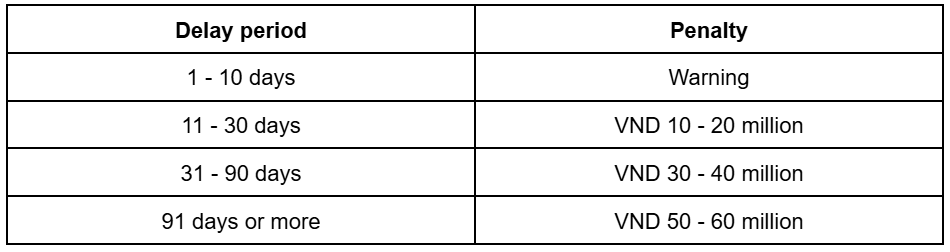
Failure to register mandatory changes may result in fines of VND 30–70 million, together with a requirement to complete the relevant filing.
Importantly, companies established before 1 July 2025 that fail to supplement BO information when making their next registration filing may be exposed to penalties of VND 70–100 million.
3. New penalties for failure to declare BO upon incorporation
Decree 288 introduces a new violation specifically targeting companies that fail to provide BO information (where applicable) when establishing a new enterprise.
Penalty: VND 50–100 million, plus a mandatory requirement to submit the missing information.
Practical implications: BO verification should no longer be treated as a post-incorporation administrative task. Investors should ensure that BO information is identified and validated before submitting incorporation documents.
4. Stronger enforcement of information requests from authorities
The business registration authority now has stronger tools to enforce information requests, including requests relating to BO information.

In both cases, companies may be required to provide or supplement the requested information.
Practical implications: Companies should ensure that responsibilities for handling requests from the business registration authority are clearly assigned internally and that supporting corporate records can be readily produced when requested.
5. Increased penalties for corporate governance and record-keeping failures
Decree 288 also raises penalties across a range of corporate governance and corporate secretarial obligations. Key areas include:
-
Failure to issue capital contribution certificates to company members;
-
Failure to display enterprise, branch or representative office, business locations signage as required;
-
Failure to retain statutory corporate records at the head office or another location prescribed in the company’s charter;
-
Failure to maintain members’ registers or shareholders’ registers;
-
Failure to maintain a list of beneficial owners;
-
Failure to record complete shareholder or member information in the members’ register or shareholders’ register; and
-
Suspension of business operations for one year without notifying the business registration authority and tax authority.
Most of these violations now carry penalties ranging from VND 40–70 million, together with mandatory corrective actions.
Practical implications: For many FDI companies, compliance risks often arise not from intentional misconduct but from incomplete corporate records, outdated shareholder registers, or documentation maintained outside Vietnam. These areas should be reviewed proactively in light of the increased penalties.
Recommended actions for businesses
Given the increased regulatory focus on BO and corporate transparency, companies should consider taking the following steps:
-
Review and verify BO information, including supporting documentation.
-
Assess whether any enterprise registration information requires updating.
-
Confirm that members’ registers, shareholders’ registers and BO records are complete and up to date.
-
Review document retention practices and ensure statutory corporate records are properly maintained.
-
Establish internal procedures for responding to information requests from the business registration authority.
-
For groups with foreign ownership structures, conduct an early assessment of BO reporting obligations and supporting evidence requirements.
Our observations
Decree 288 reflects the Government’s continued emphasis on BO transparency, corporate governance and regulatory compliance. The combination of substantially higher fines and mandatory remedial measures suggests that enforcement is likely to become more active going forward. Companies, particularly those with complex ownership structures, should review their compliance framework now to reduce the risk of regulatory scrutiny and penalties.
—
If you would like to discuss how these regulatory changes apply to your business or require tailored compliance advice, please get in touch with our team.
📧 info@indochinecounsel.com
☎️ (+84) 28 3823 9640