

Ho Chi Minh City, 23 June 2026
In last week’s article, we provided an overview of inheritance in Vietnam. In this week’s article, we outline the key aspects of inheritance at law in Vietnam. This represents the core principle of equality in inheritance protected by Vietnamese law.
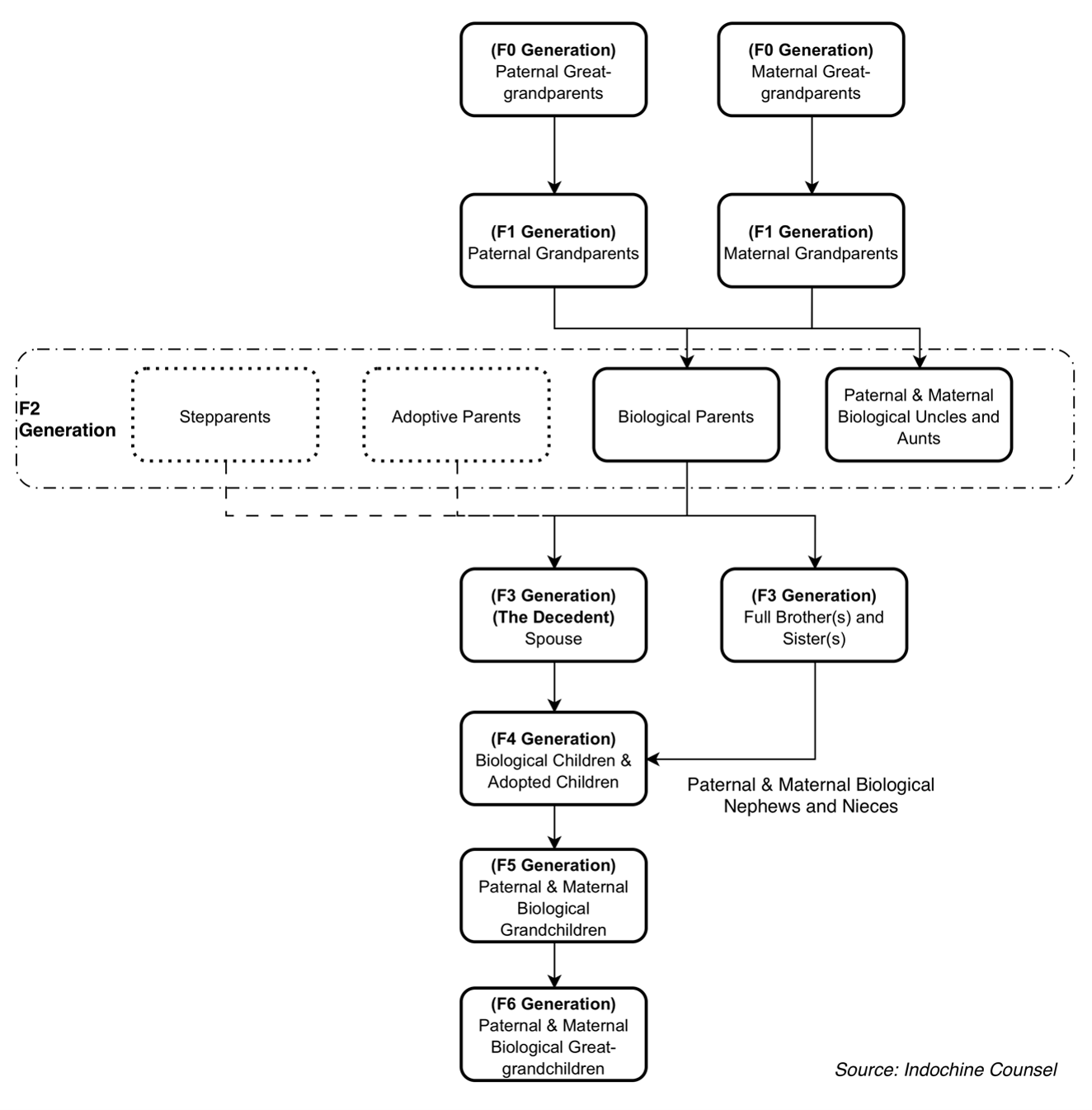
We use a hypothetical six-generation family tree below (Figure 1) to help readers follow this article.
Inheritance at Law
Inheritance at law is inheritance in accordance with the ranks, conditions, and order of inheritance prescribed by law. In principle, inheritance at law applies in the following cases:
- There is no testament, or the testament is unlawful;
- No testamentary heir(s) remain;
- The designated testamentary heir(s) are disinherited or disclaim their inheritance.
Under the viewpoint of the estate, inheritance at law also applies to:
- any part of the estate not disposed of in the testament;
- any part of the estate related to parts of the testament that are legally invalid;
- any part of the estate related to a testamentary heir(s) who is disinherited or disclaims their inheritance, or who dies (if an individual) or ceases to exist (if an entity) before or at the same time as the testator at the time of opening inheritance.
At-law heirs
Generally, heirs at law are individuals related to the estate leaver by blood, marriage, or adoption. The law defines three ranks of inheritance:
- First Rank of Inheritance: Spouse (F3 Generation), biological parents (F2 Generation), adoptive parents (F2 Generation), biological children, and adopted children (F4 Generation).
- Second Rank of Inheritance: Paternal grandparents (F1 Generation), maternal grandparents (F1 Generation), full brother(s) and sister(s) (F3 Generation), and paternal & maternal biological grandchildren (F5 Generation) (if the decedent is their paternal or maternal grandparent).
- Third Rank of Inheritance: Paternal & maternal great-grandparents (F0 Generation); paternal & maternal biological uncles and aunts (F2 Generation); paternal & maternal biological nephews and nieces (F4 Generation) (if the decedent is their biological uncle or aunt); and paternal & maternal biological great-grandchildren (F6 Generation) (if the decedent is their paternal or maternal great-grandparent).
Applying Ranks of Inheritance
- Heir(s) of the same rank are entitled to equal shares of the estate.
- Heir(s) of a lower rank are entitled to inherit only if there are no remaining heir(s) of a higher rank due to death, disinheritance, disclaimer, or loss of inheritance rights.
- Inheritance by Substitution: Where a child (F4 Generation) of an estate leaver (F3 Generation) dies before or at the same time as the estate leaver, the grandchild (F5 Generation) is entitled to inherit the share that their parent would have inherited.
If the grandchild (F5 Generation) also dies before or at the same time as the estate leaver (F3 Generation), the great-grandchild (F6 Generation) is entitled to inherit the share that their parent would have inherited if still alive.
Inheritance at Law in several Special Relations
The Civil Code 2015 regulates inheritance rights in several special relationships (distinguished from biological / blood relationships) as follows:
- Adoptive Relationship: An adopted child (F3 Generation) and their lawful adoptive parents (F2 Generation) may inherit from each other’s estates. They are placed in the first rank of inheritance and entitled to inheritance by substitution.
- Step-relationship: Where stepchildren (F3 Generation) and stepparents (F2 Generation) care for and support each other as parents and children, they may inherit from each other’s estates in the same manner as adoptive relations.
- Spousal Relationship in special cases:
- A surviving spouse is still entitled to inherit the decedent’s estate even if the spouses had divided their common property during their marriage.
- A surviving spouse is entitled to inherit the decedent’s estate if the spouses had applied for divorce but the court has not yet issued a final judgment or decision, or if such judgment or decision has not yet taken legal effect.
- A person who is the spouse of the decedent at the time of the decedent’s death is still entitled to inherit even if they subsequently remarry.
Conclusion
In essence, estate distribution under inheritance at law applies when there is no (valid) testament. Therefore, when making a testament, estate leavers must carefully evaluate these rules to ensure their testament is drafted and executed properly, reflecting their actual will.
We will analyze testamentary inheritance in the next part of this series.
—
Read the previous part here: Part 1
—–
For advice on inheritance, testamentary planning and estate distribution in Vietnam, please contact our team:
📧 info@indochinecounsel.com
☎️ (+84) 28 3823 9640